
Back to Resources
Are Municipalities Using Social Media Effectively, Or Just Posting Into the Void?
Blog
April 29, 2026

At SmartFusion, we talk a lot about building trust and connecting people. It’s easy to think of that in terms of systems, data, and operations. But trust isn’t built in the back office alone. It shows up in how local governments communicate every day.
For most residents, social media is where that connection happens first.
It’s where they look for updates, ask questions, and form opinions about how their city or county is doing. That makes it more than a communication channel. It’s part of the service itself.
And that raises an important question: are municipalities using social media to simply share information, or to actually connect with the people they serve?
I’ve sat through enough meetings to know how this goes.
Someone says, “We posted it on social media, so we should be covered.” Then everyone moves on.
But that’s not the job.
Posting is easy. Doing it well takes thought, time, and a bit of grit. Most Comms teams are already stretched thin. They’re juggling council agendas, media calls, internal requests. Social media ends up feeling like an extra task. Something that you squeeze in.
And that’s the problem.
Citizens don’t see it that way. To them, your social feed is the front door. It’s where they go first. Not the website. Not a press release.
So the question is simple: are you using it to talk with the public, or just pushing information out and hoping for the best?
Define the Purpose Before You Post
A lot of municipal feeds feel scattered. One post about a road closure. Then a holiday graphic. Then a council recap that gets no traction.
There’s no clear thread. And people notice.
It usually comes down to one thing: no defined goal. Nobody stopped to ask what the post is supposed to do.
Every post needs a job. Inform. Reassure. Sometimes calm people down. Sometimes just show that the city is paying attention.
I remember watching a council meeting that got heated over something that should have been routine. The issue itself wasn’t the problem. They didn’t explain it and social media filled the gap with speculation.
That one stuck with me.
Now you need to ask a simple question before anything goes out: what’s the outcome? If there isn’t one, rethink it.
Platform Best Practices That Actually Work
Let’s be honest. Copying the same message across every platform is common. It’s also ineffective.
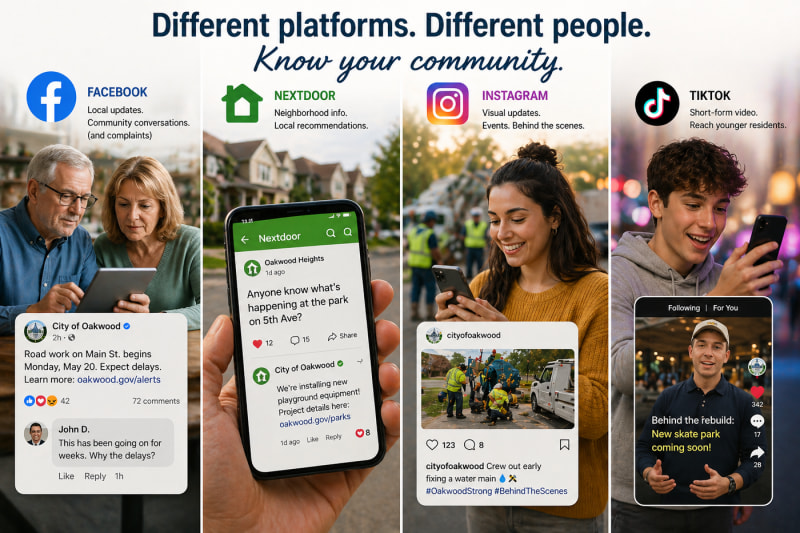
Facebook remains a strong workhorse for municipal communications, particularly with older and middle-aged residents who rely on it for local updates. It's also where complaints tend to surface. Longer posts are fine, but they need to sound like a person wrote them. Not a policy memo. That said, younger residents are increasingly turning to Nextdoor, Instagram, or even TikTok for local information, so it's worth knowing your community's demographics before assuming Facebook reaches everyone.
And here’s the part some teams avoid: responding (I’m guilty of this myself). If someone takes the time to comment, and the city says nothing, it feels like no one is listening.
Instagram and Reels are a different animal. Less formal. More visual. This is where you show the human side of government. A quick clip of a crew fixing a water line. A behind the scenes look at an event. It doesn’t have to be perfect. It just has to feel real.
LinkedIn gets overlooked. It shouldn’t. That’s where you speak to professionals, potential hires, business leaders. It’s a chance to show that your municipality is stable and well run.
Different platforms. Different expectations. It takes effort to adjust. But it pays off.
Engagement Is Not Optional
This is where things get uncomfortable.
Because once you open the door, people walk in. And they bring opinions with them.
We’ve all seen it. One post. Dozens of comments. Some fair, some not. And a tone that sets people off because it feels cold or bureaucratic.
Ignoring it doesn’t help.
Engagement doesn’t mean arguing. It means showing up. Acknowledging concerns. Giving a response that sounds like it came from a real person.
A few habits make a difference:
- Ask a question now and then. Keep it simple.
- Share something local. A small win, a moment people recognize.
- And when someone’s frustrated, respond. Even if the answer is incomplete.
Or ask yourself this: if a citizen came up to the counter in person, would you ignore them?
Communicating During a Crisis
This is where social media either earns trust or loses it.
When something goes wrong, people go straight to their phones. They check Facebook first. They’re looking for answers.
And this is where hesitation creeps in. Teams want to wait until every detail is confirmed.
That delay can cost you.
During a crisis, timing becomes everything. And this is where many municipalities struggle.
From working with local governments, it’s clear that the instinct is to wait until information is fully confirmed. That makes sense internally. But publicly, it creates a gap.
And gaps get filled quickly.
Residents start sharing their own versions of events. Questions pile up. By the time an official post goes out, it’s often playing catch-up.
The more effective approach is direct: communicate early. Share confirmed details. Acknowledge what’s still unknown. Commit to updates, and follow through.
Clarity matters. Speed matters more.
Core Competencies for Government Comms Teams
This work isn’t theoretical. It’s practical. Day to day.
Clarity of purpose matters. If the Comms team doesn’t understand the goal, the public won’t either.
Transparency is non negotiable. You’re operating in a public record environment. That carries weight.
Accessibility is part of the job. Captions on videos. Alt text on images, and this one gets skipped more often than it should. Plain language. Graphics that can actually be read on a phone screen. These aren't optional extras. They're part of reaching everyone in your community, and in many cases they're legally expected of government entities.
And then there’s time management. This is where most teams feel the strain.
You build what you can:
- A simple content calendar
- Some posts prepared ahead of time
- And an understanding that some weeks will be reactive. That’s just reality.
No perfect system. Just better habits.
Practical Resources Worth Using
You don’t need to start from scratch.
There are solid resources out there. Many teams just don’t have the time to track them down.
A few that are worth it:
- FEMA and Ready.gov for crisis communication guidance
- Accessibility checklists. Not exciting, but necessary
- Platform guidance from Meta and LinkedIn
And one more thing. Talk to other PIOs. That network is stronger than people think. A quick conversation can save you hours of trial and error.
Final Thought
Local government is about service. That hasn’t changed.
But expectations have. The public wants faster updates. Clear language. A human tone.
Social media often gets treated like a side task. Something you handle after everything else.
That mindset needs to shift.
Handled well, it builds trust over time. Handled poorly, it chips away at it.
Most people in this field already know that. They just need the support, and sometimes the permission, to do it right.