
Back to Resources
Cloud Hosting and Online Documents: A Smarter Way to Keep Local Government Running
Blog
May 4, 2026
Summary
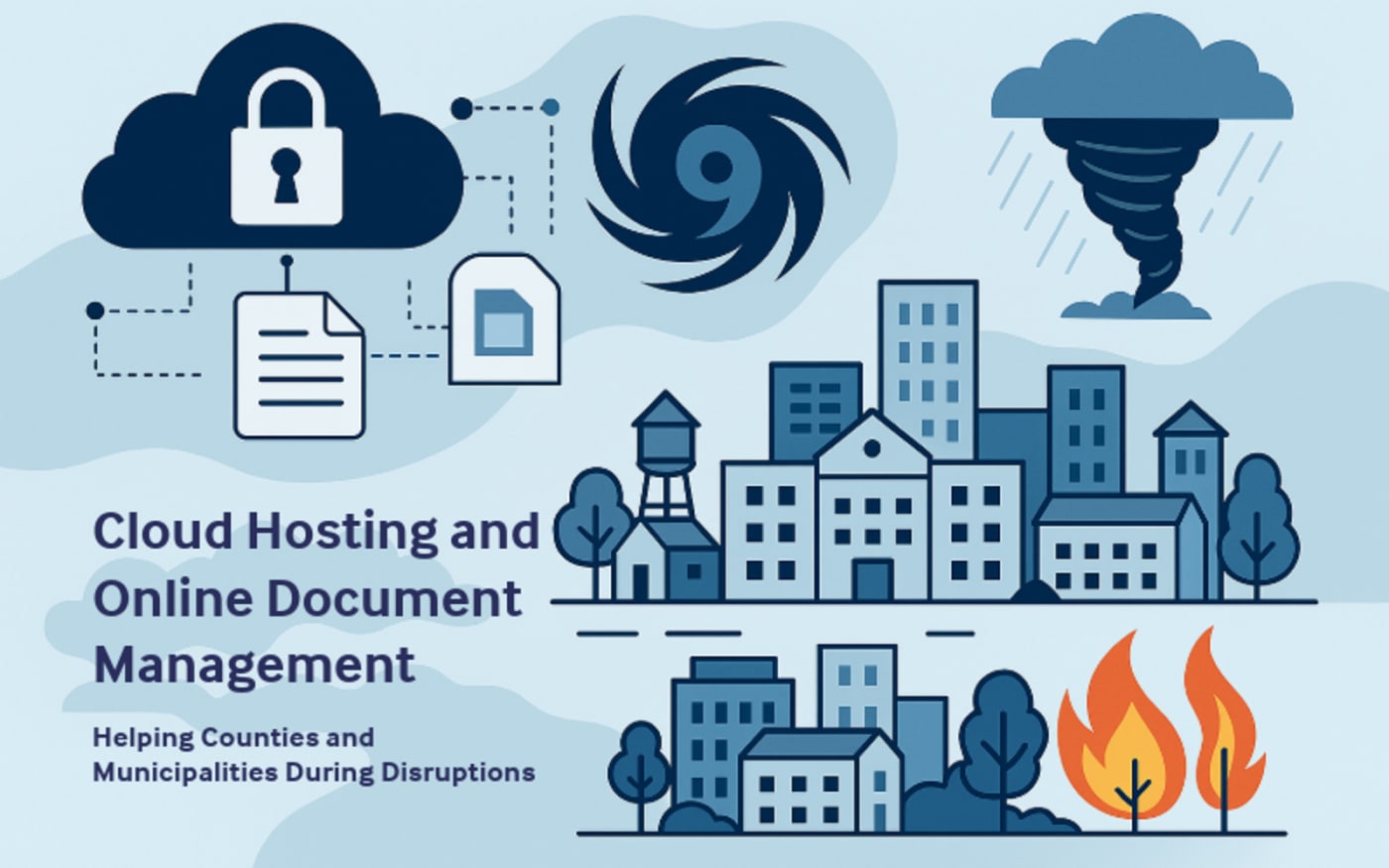
When offices close because of storms, fires, or extended outages, local government work does not stop. Payroll still has to run. Utility bills still need processing. Crews still need work orders.
Cloud hosting and online document management give cities and counties a practical way to keep operating when buildings are unavailable or staff cannot get to their desks. Moving critical systems and records off local servers and paper files reduces downtime, supports remote work, and helps governments recover faster, both during emergencies and in day‑to‑day operations.
This is not about chasing technology trends. It is about continuity.
The Next Storm Should Not Decide Whether City Hall Works
Across Texas, Louisiana, Mississippi, Florida, Alabama, Georgia, North Carolina, and South Carolina, disaster planning is not theoretical.
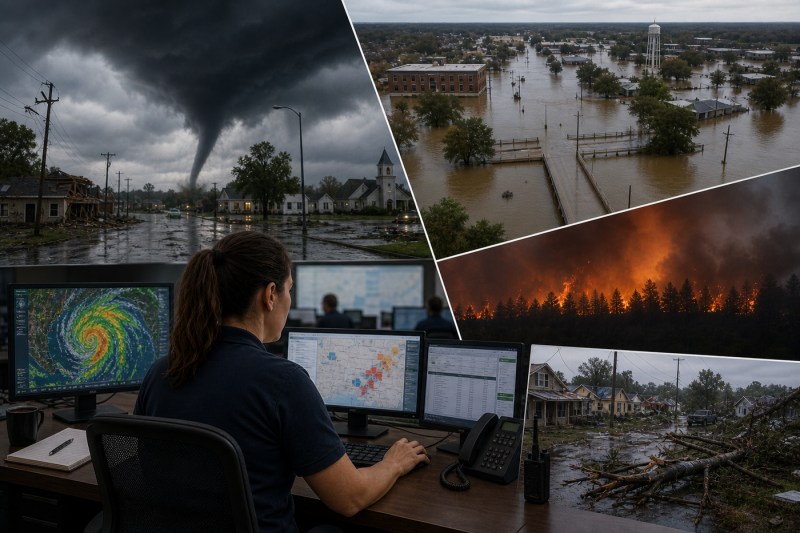
Hurricanes shut down offices for days. Tornadoes arrive with little warning. Flooding blocks roads. Wildfires and smoke force evacuations and then power outages stretch longer than planned.
During all of this, residents still expect government to function.
They need to pay bills. Contractors need permits. Employees need paychecks. Public works needs assignments. Finance needs access to purchase orders, invoices, and emergency spending records.
Leadership needs current information to make decisions under pressure.
That is why cloud hosting and online document management belong in the same conversation as emergency preparedness. This is not just an IT upgrade. It is an operational decision.
Why This Matters in the Gulf Coast and Southeast
Weather disruption is part of the operating environment. NOAA data shows that from 1980 through 2024:
- Texas recorded 190 billion‑dollar weather and climate disaster events
- Louisiana recorded 106
- Mississippi recorded 108
Similar patterns show up across the Southeast, with Alabama, Georgia, Florida, North Carolina, and South Carolina all experiencing more than 90 such events over the same period.
FEMA’s National Risk Index tracks exposure across hazards like hurricanes, tornadoes, flooding, wildfire, and extreme wind. Local leaders do not need a chart to know the reality. They see it in budgets, staffing strain, and recovery timelines.
Keeping critical systems tied to one building, one server room, or one filing area adds risk that is largely avoidable.
Municipal Leaders Are Already Weighing the Cost of Downtime
This conversation is already showing up in public meetings, budget workshops, and council discussions. Cities and counties are looking at cloud hosting, document management, and ERP modernization not because the technology is new, but because the operating risk is familiar.
There is a cost. Local leaders know that. Councils, commissions, finance directors, clerks, and IT teams all have to justify spending carefully.
But the better question is not only, “What does cloud hosting cost?”
The better question is, “What does downtime cost?”
What does it cost when payroll is delayed, invoices cannot be processed, permits cannot be retrieved, or public works documentation is scattered across paper files and local folders? What does it cost when staff spend days rebuilding information that should have been protected?
That is why more local governments are treating cloud hosting and online document management as long-term operating safeguards, not optional add-ons.
For agencies already using an ERP system, the conversation becomes even more practical: how do we protect the systems and records that keep daily government work moving?
Cloud hosting has a cost, but disruption has a cost too.
What Cloud Hosting Actually Solves
Cloud hosting reduces dependence on a single physical location. When a facility is damaged or inaccessible, staff still need to reach the systems that keep government running.
Cloud‑hosted systems allow continued access to:
- Financial management and reporting
- Payroll and HR records
- Utility billing and customer accounts
- Accounts payable and purchasing
- Permitting and licensing workflows
- Decision‑support reports
- Online payments and resident communications
NIST’s contingency planning guidance emphasizes recovery strategies, alternate sites, and tested restoration procedures. Cloud hosting supports that goal in practical terms. There are fewer single points of failure and faster recovery when something goes wrong.
For SmartFusion users, this is already built into the model. SmartFusion offers a SaaS platform hosted in secure data centers, supporting remote access, scalability, and continuity for local government operations.
Why Document Management Cannot Be an Afterthought
Cloud-hosted systems help, but they only go so far if supporting documents are still locked in file cabinets or scattered across shared drives.
Paper does not travel well during an emergency.
Neither do local folders that only one person understands.
Online document management gives authorized staff a secure way to retrieve critical records from wherever they are working, whether that is home, a temporary office, or an emergency operations center.
Records planning has to account for the practical ways paper fails during a disaster: water damage, mold, smoke, heat, contamination, and files left behind in a closed building. One practical way to reduce that risk is to move critical records into a secure online document management system.
In practice, online document management protects access to:
- Invoices and purchase orders
- Contracts and vendor files
- Council minutes and ordinances
- Permits, inspections, and licenses
- Personnel and payroll documents
- Utility account records
- FEMA reimbursement documentation
- Audit support files
For SmartFusion agencies, document management is not just about convenience. It helps preserve access to the records staff need to support financial activity, resident service, audits, reimbursements, and daily operations.
The Finance Reality During Disasters
Disasters create documentation pressure fast.
Emergency purchases happen quickly. Overtime, equipment rental, debris removal, fuel, and temporary repairs need to be tracked accurately. Weeks or months later, auditors and reimbursement agencies will want proof.
Without cloud access and online documents, finance teams often rely on memory, spreadsheets, or paper files that were not designed for emergency conditions. That increases risk.
Cloud hosting and document management allow finance teams to:
- Process accounts payable remotely
- Access purchase orders and approvals outside the office
- Maintain audit trails during emergency spending
- Assemble reimbursement documentation faster
- Keep leadership informed on financial impact
SmartFusion’s financial tools, including fund accounting, budgeting, accounts payable, purchasing, bank reconciliation, fixed assets, and reporting, are designed for public sector compliance and visibility when conditions are not ideal.
When finance can keep working, vendors get paid, crews stay supplied, and response efforts do not stall because paperwork is inaccessible.
Clerks, Records, and Legal Continuity
Clerks and records teams carry the institutional memory of local government. During a disruption, that role becomes even more critical.
Online document management reduces reliance on institutional knowledge trapped in one office or one person’s desk. Staff can search, retrieve, and share authorized records without asking who has the file.
That matters for council actions, emergency declarations, procurement records, and public notices. Even under pressure, governments still have to operate lawfully and transparently.
Public Works in the Field
Public works crews are usually first on scene and last to stand down.
They document damage, clear roads, track labor and materials, and coordinate repairs, often from the field. Cloud access matters when supervisors are not sitting at a desk.
SmartFusion’s Work Orders with Mobile module supports field execution with photos, time tracking, routing, assignments, and reporting. A photo attached to a work order can support internal review, insurance claims, or reimbursement. Accurate time and material tracking helps explain what happened and what it cost.
Those details matter long after the storm passes.
Utilities and Customer Service Expectations
After a major event, residents do not want to hear that the billing system is offline.
They want to know whether service is safe, whether payments can still be made, and how fees are being handled. Cloud‑hosted billing and online payments reduce pressure on front counters and call centers when frustration is already high.
SmartFusion supports utility billing, revenue management, MyGovHub online payments, eBilling, notifications, and citizen self‑service, along with phone, mobile, IVR, pay‑by‑text, and mass notification options.
That does not eliminate disruption, but it gives staff options and residents clarity.
What This Means for IT Teams
Cloud hosting does not eliminate IT responsibility. It shifts it.
Instead of maintaining aging local servers and managing physical exposure, IT teams can focus more on access controls, testing, vendor management, cybersecurity, and user training.
Resilience also includes cyber incidents. Guidance from NSA, CISA, FBI, and MS‑ISAC highlights cloud backups and Zero Trust approaches as part of ransomware preparedness. The takeaway is straightforward. Continuity planning is not just about weather.
A Practical Way to Start
For governments facing budget limits and competing priorities, this does not have to happen all at once.
- Identify functions that cannot stop
Payroll, utility billing, accounts payable, purchasing, work orders, permitting, records, and emergency reporting. - Map the documents behind those functions
What is on paper. What is on desktops. What is in shared drives. What is required for audit or reimbursement. - Prioritize cloud hosting for critical systems
Reduce reliance on local equipment where downtime hurts the most. - Define access rules early
Role‑based permissions, secure authentication, and training before emergencies happen. - Test before storm season
Remote logins, document retrieval, emergency purchases, and reporting. Untested plans fail when they are needed most.
The Bottom Line
Cloud hosting and online document management help local governments keep working when conditions are not normal.
They protect access, reduce downtime, support remote work, preserve records, and maintain public trust. Most importantly, they help staff serve residents when communities need government the most.
A storm should not decide whether payroll runs.
A flooded office should not decide whether a permit can be found.
A power outage should not decide whether residents can pay a bill.
For local governments across the Gulf Coast and Southeast, resilience is not a future goal. It is part of the job, and cloud hosting and online document management make that job more manageable.
Learn More About SmartFusion Cloud Hosting and Document Management
Preparing for the next disruption starts before the next storm, outage, or emergency. SmartFusion’s cloud hosting and document management options help local governments protect access to critical systems, reduce reliance on paper records, and keep essential work moving when offices are closed or staff are working remotely.