
Back to Resources
How Small Municipalities Can Strengthen Internal Controls Without Adding Staff
Blog
June 10, 2026
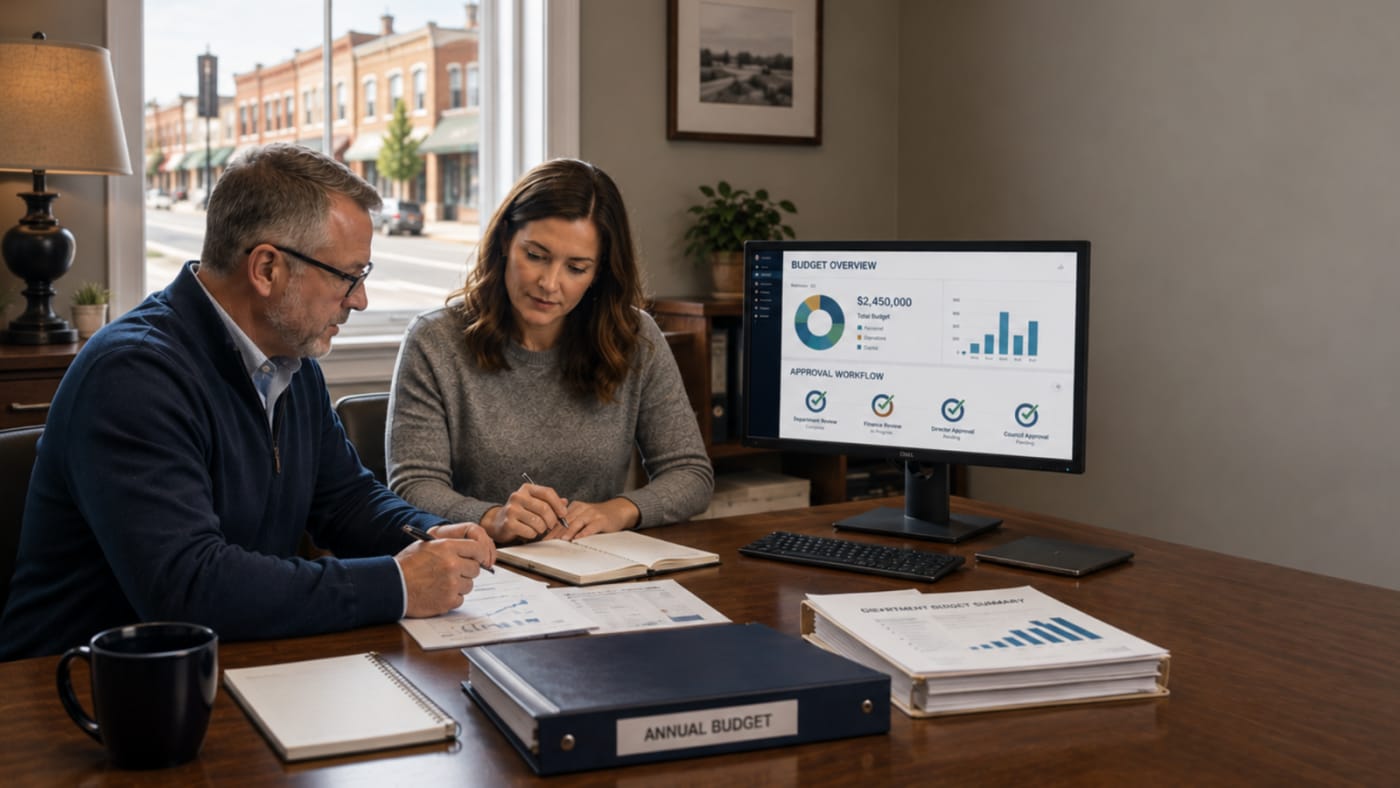
Small municipalities often operate with limited staff, making financial oversight a daily challenge. Strong municipal internal controls reduce risk, improve accountability, and support audit readiness. This guide outlines practical steps local governments can take to strengthen approvals, reconciliations, reporting, and visibility without adding personnel or overburdening the finance department today.

The Stewardship of Every Public Dollar
Budgets are tight. Staff resources are limited. And expectations, especially around transparency, keep rising.
In many small municipalities, the finance function isn’t a department. It’s a person. Sometimes two. The same employee might handle deposits in the morning, enter invoices after lunch, and reconcile accounts at month-end.
That’s not unusual. But it does create risk.
Not because people aren’t doing their jobs, but because the process depends too heavily on memory, habit, and trust. Those don’t hold up well under audit pressure or staff turnover.
Most small towns aren’t behind because they’re careless. They’re stretched. Systems get layered over time. Workarounds become “the way we do things.”
The good news is most control gaps don’t require more staff to fix. They require clearer structure and a few well-placed review points.
For example:
- A department head signs off before a purchase moves forward
- A manager reviews reconciliations monthly, even at a high level
- Supporting documentation lives in one place instead of inboxes and folders
Small changes like these don’t slow work down. They make it easier to prove what happened later.
At the end of the day, internal controls aren’t about adding process. They are about making sure the process you already rely on can stand up when it’s tested.
That’s what financial stewardship looks like in practice.
What Are Internal Controls in Local Government?
Internal controls are policies, procedures, and safeguards that help local governments protect public funds, maintain accurate financial records, and comply with regulatory requirements.
Municipal internal controls are the guardrails of public finance. They help ensure that money is received, recorded, spent, reviewed, and reported in a responsible manner.
Strong local government financial controls support:
- Protection of taxpayer resources
- Accurate fund accounting and financial reporting
- Consistent approval and review procedures
- Clear documentation for auditors
- Transparency for elected officials and citizens
At their best, internal controls are not paperwork for paperwork’s sake. They are the machinery of public trust.
Why Is Segregation of Duties Important for Municipalities?
Segregation of duties reduces risk by ensuring that no single employee controls every step of a financial transaction.
In a large city, one employee may enter invoices, another may approve payments, another may reconcile the bank account, and another may review reports. In a small municipality, those duties often fall to one or two people.
That is where risk grows.
Segregation of duties in local government matters because it helps prevent errors, detect inconsistencies, and reduce dependence on a single employee. It also protects staff. No good employee should be placed in a position where trust is the only control.
Common incompatible duties include:
- Creating vendors and approving vendor payments
- Receiving cash and reconciling bank deposits
- Entering payroll changes and approving payroll
- Issuing purchase orders and approving invoices
- Recording journal entries and reviewing financial reports
Small towns may not be able to fully separate every function. But they can still build review points.
A department head can approve purchases.
A clerk can prepare deposits.
A manager, mayor, or council designee can review monthly reconciliations.
The goal is not perfection. The goal is oversight.
What Causes Audit Findings in Local Governments?
Most audit findings in local governments are caused by weak documentation, limited review procedures, poor segregation of duties, delayed reconciliations, inconsistent approvals, or difficulty producing accurate financial records.
Audit findings do not always mean wrongdoing. Often, they mean the process was too informal.
A local government may be doing the work, but not documenting the work. A finance clerk may know exactly why a transaction occurred, but the record may not show approval, backup, or review.
That gap matters.
“Most audit findings do not begin with fraud. They begin with weak processes, inconsistent reviews, and limited visibility.”
Common causes of municipal audit findings include:
- Bank reconciliations are not completed on time
- Journal entries lack review or supporting documentation
- Purchase approvals are handled manually or inconsistently
- Budget amendments are not clearly tracked
- Payroll changes are not independently reviewed
- Grant or restricted funds are not properly monitored
- Financial reports are difficult to produce or explain
Audit readiness begins long before the auditor arrives.
Common Warning Signs That Internal Controls Need Improvement
Small municipalities should review their internal controls when daily work depends too heavily on memory, spreadsheets, or one trusted employee.
Warning signs include:
- One employee handles multiple financial processes without review
- Approvals happen by email, paper notes, or verbal instruction
- Supporting documents are hard to locate
- Reconciliations are delayed or inconsistent
- Financial reports require manual spreadsheet work
- Department heads cannot easily see budget status
- Auditors repeatedly request the same missing documentation
- Turnover creates confusion because processes are not written down
These signs are not failures. They are signals.
They tell leaders where to act.

How Can Small Towns Improve Internal Controls With Limited Staff?
Small towns can improve internal controls by documenting procedures, assigning review responsibilities, using approval workflows, standardizing reconciliations, and adopting municipal finance software that increases visibility without adding manual work.
The most practical path is to build controls into the work already being done.
1. Create Documented Approval Processes
Every municipality should define who can approve purchases, payroll changes, journal entries, budget amendments, refunds, and voids.
The policy does not need to be complex. It needs to be clear.
Document:
- Who initiates the transaction
- Who approves it
- What dollar thresholds require additional review
- What backup must be attached
- Where the approval is stored
- How exceptions are handled
When approvals are documented, staff are protected. Managers are informed. Auditors have a record.
2. Separate Financial Responsibilities Where Possible
Small municipalities may not have enough staff to fully separate every duty. That is reality.
But they can separate key points of control.
For example:
- The person who opens mail should not be the only person recording payments
- The person who prepares checks should not be the only person approving disbursements
- The person who enters payroll changes should not be the only person reviewing payroll
- The person who reconciles bank accounts should not be the only person reviewing the reconciliation
When staff size is limited, use management review. Use council review. Use department-level approval. Use technology-based permissions.
A second set of eyes can change the culture of control.
3. Improve Reconciliation Procedures
Reconciliations are where confidence is built.
Bank accounts, cash drawers, utility billing, accounts receivable, payroll liabilities, and fund balances should be reconciled on a regular schedule.
A strong reconciliation process includes:
- A defined completion deadline
- Supporting documentation
- Review by someone other than the preparer, where possible
- Clear notes for outstanding items
- Retention of reconciliation records
- Follow-up on unresolved differences
Reconciliations should not be a year-end rescue mission. They should be part of monthly discipline.
4. Standardize Financial Reporting
Local government financial controls are stronger when leaders can see the same reports, on the same schedule, with the same definitions.
Standard reports may include:
- Budget-to-actual statements
- Fund balance reports
- Cash balance reports
- Accounts payable aging
- Revenue collection reports
- Payroll summary reports
- Purchase order status reports
Standard reporting reduces confusion. It gives councils and administrators a shared view of financial reality.
A town that sees its numbers can govern with confidence.
5. Use Technology to Support Oversight
Technology cannot replace judgment. It can strengthen judgment.
Municipal finance software can help small towns reduce manual work, apply security permissions, centralize financial records, route approvals, and produce reports without relying on scattered spreadsheets.
SmartFusion, for example, is described as an integrated ERP solution for municipalities and public sector organizations, combining financial management, payroll and HR, billing, revenue management, utility billing, and reporting tools in one platform. Its financial management capabilities include fund ledger, budgeting, accounts payable, bank reconciliation, fixed assets, purchasing, and project reporting.
That matters because internal controls depend on connection.
When purchasing connects to the fund ledger.
When accounts payable connects to reporting.
When bank reconciliation connects to financial review.
The process becomes clearer. The record becomes stronger.
How Can Software Support Municipal Financial Oversight?
Modern municipal finance software helps improve internal controls by centralizing financial information, providing approval workflows, supporting reporting, and increasing visibility across departments.
For small town financial management, software should support oversight in practical ways.
Key features include:
- User-defined security permissions
- Purchasing approval workflows
- Budget monitoring and reporting
- Integrated fund accounting
- Accounts payable controls
- Bank reconciliation tools
- Financial reporting with drill-down access
- Historical records for audit support
- Role-based access for staff and managers
SmartFusion source materials describe a public sector financial management suite that includes Fund Ledger, Budget Preparation, Accounts Payable, Purchasing, Bank Reconciliation, Fixed Assets, and Project Reporting. They also highlight built-in reporting capabilities, Executive Dashboards with interactive visual reporting and drill-down analysis, Excel export functionality, and Microsoft Office integration for analysis and information sharing. The platform provides financial visibility through customizable dashboard tiles, departmental trend analysis, and reporting tools that support informed decision-making.
The module descriptions also show how specific functions support financial controls and accountability. Purchasing manages purchase orders and integrates with Fund Ledger, Accounts Payable, and Inventory. Fixed Assets helps track asset status and depreciation. Budget Preparation supports multiple budget models, departmental input workflow, forecasting, and reporting. Cost Allocation helps distribute shared and indirect costs across funds, departments, programs, and cost centers with consistency and transparency.
This is not just government accounting software. Used well, it becomes a control framework.
How Do Municipalities Reduce Financial Risk Without Hiring Additional Staff?
Municipalities reduce financial risk without hiring additional staff by assigning review roles, limiting system access, documenting approvals, reconciling accounts monthly, standardizing reports, and using local government ERP software to automate controls.
The question is not always, “Who else can we hire?”
Sometimes the better question is, “Where can we build review into the process?”
Practical steps include:
- Restrict access by role
Employees should only have access to the functions required for their job. - Require documented approvals
Purchases, payroll changes, refunds, journal entries, and budget adjustments should leave a record. - Review exception reports
Managers should monitor unusual transactions, budget overages, voids, and adjustments. - Reconcile monthly
Do not let unresolved items travel from month to month without review. - Use system reports instead of spreadsheet workarounds
Spreadsheets are useful, but they should not become the official control environment. - Create backup procedures
One employee should not be the only person who knows how to process payroll, close a month, or prepare audit records.
Small municipalities do not need heavier bureaucracy. They need lighter processes with stronger proof.
What Should Be Included in a Municipal Internal Controls Checklist?
A municipal internal controls checklist should include approval procedures, segregation of A strong internal controls checklist doesn’t need to be complicated, but it does need to reflect how work actually happens in your organization.
The goal isn’t to check boxes. It is to make sure key moments, approvals, reconciliations, and reviews, are visible and repeatable.
Here’s a practical baseline most small municipalities can build from:
Municipal Internal Controls Checklist
Governance and Oversight
- Financial policies are documented and reviewed periodically, not just filed away
- Council or leadership receives consistent monthly financial reports
- Budget amendments are tracked with clear approval history
- Unusual activity or exceptions are identified and discussed, not ignored
Cash Receipts and Deposits
- Payments are recorded as they’re received, not batched days later
- Deposits follow a consistent schedule
- Cash drawers are balanced daily where applicable
- Someone other than the preparer periodically compares deposits to system records
Purchasing and Accounts Payable
- Purchases are approved before commitments are made, even informally for smaller amounts
- Changes to vendor records are reviewed, especially banking details
- Invoices are matched to purchase orders or documented approvals
- Payment runs, whether checks or ACH, are reviewed before release
Payroll
- New hires and pay changes have documented approval
- Time records are reviewed, even in small teams
- Payroll registers are checked before processing, not after
- Benefit deductions and leave balances are reviewed periodically for accuracy
Bank Reconciliation
- Bank reconciliations are completed monthly. They should not drift to quarter-end
- Outstanding checks and deposits are reviewed and followed up on
- Adjustments are documented clearly, not loosely explained or guessed
- Someone other than the preparer reviews the reconciliation, even at a summary level
System Access
- Access matches job responsibilities. No one has extra permissions “just in case”
- Former employee access is removed promptly. This is commonly overlooked
- Administrative privileges are limited and reviewed periodically
- Access reviews happen at least annually or when roles change
Financial Reporting
- Budget-to-actual reports are reviewed monthly by both finance and department leaders
- Fund balances are monitored and understood, not just reported
- Grant and restricted funds are tracked separately and consistently
- Reports are generated from the system instead of being rebuilt in spreadsheets whenever possible
Audit Documentation
- Supporting documents are stored in a consistent, shared location
- Prior audit findings are tracked with clear follow-up actions
- Audit requests can be answered without rebuilding history
- Key records, including approvals, reconciliations, and reports, are retained and easy to locate
This checklist is not meant to slow your team down. If anything, it should reduce rework, especially during audits or staff transitions.
If a process works today but would be hard to explain six months from now, that is usually where a control needs to be tightened.
How Can Local Governments Prepare for an Audit?
Municipal audit readiness requires documented processes, consistent reconciliations, clear approval procedures, and accurate financial reporting. Technology can help centralize these activities and improve access to supporting documentation.
Audit preparation should be a year-round discipline, not a year-end event.
Local governments can prepare for an audit by:
- Maintaining monthly reconciliations
Bank accounts, cash, receivables, payables, payroll liabilities, and fund balances should be reviewed throughout the year. - Keeping approval records organized
Auditors need to see who approved what, when, and with what support. - Reviewing budget compliance
Budget-to-actual reports should be monitored regularly so issues are not discovered too late. - Tracking prior findings
If a prior audit noted weaknesses, assign responsibility and document corrective action. - Centralizing records
Scattered files, inboxes, and spreadsheets make audit response harder. - Using reports that can be reproduced
Audit support is stronger when reports come from a consistent financial system.
SmartFusion’s public sector materials state that its platform supports GAAP, GAAFR, and GASB standards, includes full module integration, and provides reporting tools for public sector financial management.
Audit readiness is not about impressing auditors. It is about proving stewardship.
The Stewardship of Finance: Impact on the Finance Department
Strong internal controls help finance departments work with less stress and more confidence.
For small teams, the benefits are practical:
- Reduced manual processes
- Fewer duplicate entries
- Better documentation
- Faster reporting
- Easier municipal audit preparation
- Less reliance on institutional knowledge
- Clearer backup procedures during turnover
This matters in the trenches.
When the finance director is out.
When the clerk retires.
When the auditor asks for support from nine months ago.
A strong process stands when people are unavailable.
The Public Trust: Impact on Elected Officials and Citizens
Internal controls are not only a finance issue. They are a governance issue.
Elected officials need accurate reports to make responsible decisions. Citizens need confidence that public money is handled with care. Staff need systems that make the right process easier to follow.
Strong local government internal controls support:
- Better financial visibility
- Increased confidence in reporting
- Improved transparency
- Protection of taxpayer resources
- More informed council decisions
- Stronger public accountability
Citizen Impact Statement:
This is not just about financial processes. Strong internal controls help local governments demonstrate responsible stewardship of public funds and strengthen citizen confidence in local government operations.
A municipality that protects its records protects its reputation.
A municipality that strengthens oversight strengthens trust.
A municipality that honors the public dollar honors the public itself.
Recent News


