Back to Resources
GASB 103: A Practical Financial Reporting Checklist for Municipal Finance Directors
Blog
November 11, 2026

GASB Statement 103 changes how local governments present financial information, including management's discussion and analysis, proprietary fund revenues, and budgetary comparisons. With additional subsidy guidance issued in September 2026, municipal finance directors should review transaction classifications, maintain accurate General Ledger records, and prepare supporting documentation before financial reporting deadlines arrive.
What GASB 103 Means for Municipal Financial Reporting
For municipal finance departments, year-end reporting already requires careful coordination. GASB Statement No. 103, Financial Reporting Model Improvements, introduces changes that deserve attention before the next audit.
Effective for fiscal years beginning after June 15, 2025, the standard applies to state and local governments preparing financial statements under governmental generally accepted accounting principles (GAAP). Specific requirements depend on the government's funds, activities and reporting structure.
The standard addresses five areas:
- Management's Discussion and Analysis (MD&A): A revised five-section structure emphasizes significant financial changes and explanations.
- Proprietary fund reporting: Updated operating and nonoperating classifications, including separate presentation of noncapital subsidies.
- Unusual or infrequent items: Replaces the previous extraordinary and special item classifications.
- Major component units: Changes how major component unit information is presented.
- Budgetary comparisons: Requires applicable comparisons to appear as required supplementary information (RSI).
For the general fund and each major special revenue fund with a legally adopted annual budget, the comparison must show the original budget, final budget and actual results, along with variances between original and final budgets and between final budgets and actual results.
Significant variances must be explained in the accompanying RSI notes rather than the MD&A.
These requirements make accurate account classifications, budget amendments and supporting records especially important.
September 2026 Guidance: Understanding Subsidies and Transfers
In September 2026, GASB issued Implementation Guide No. 2026-1, Financial Reporting Model Improvements, Subsidies.
The guide clarifies subsidy reporting under GASB 103. It is effective for fiscal years beginning after June 15, 2026, with earlier application encouraged when GASB 103 has been implemented.
For municipalities operating enterprise funds, including water and sewer utilities, several distinctions deserve attention.
Transfers between funds: GASB 103 includes all transfers in its subsidy definition. Proprietary fund reporting must distinguish noncapital subsidies from capital subsidies.
Payments in lieu of taxes (PILOTs): Classification depends on the substance of the arrangement. Finance teams should determine whether payments represent subsidies or compensation for goods or services.
Capital appropriations and contributions: Restrictions imposed by funding providers, legislation or regulations affect classification. Using unrestricted funds for capital improvements does not automatically make those resources capital subsidies.
These distinctions can affect how revenues and expenses appear in proprietary fund financial statements.
Finance teams should review agreements, funding restrictions and transaction documentation with their auditors before finalizing classifications.
A GASB 103 Readiness Checklist for Finance Directors
Use this checklist during financial reporting and audit preparation:
- Review General Ledger accounts and reporting classifications.
- Identify applicable proprietary fund subsidies, transfers and PILOT arrangements.
- Document external restrictions on capital funding.
- Review operating and nonoperating classifications.
- Prepare the revised MD&A with supporting financial explanations.
- Verify original budgets, final budgets and actual results for applicable funds.
- Document significant budget variances in RSI notes.
- Review unusual or infrequent items and major component unit presentation.
- Reconcile fund balances and retain supporting records.
- Evaluate transition requirements and applicable GASB 100 accounting change disclosures.
- Confirm subsidy guidance and reporting decisions with external auditors.
How SmartFusion Supports Financial Reporting Preparation
Accurate reporting begins with dependable financial records.
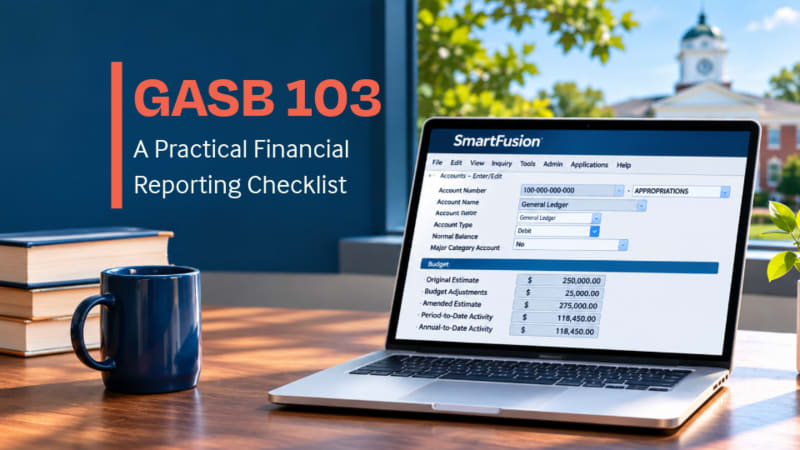
SmartFusion's General Ledger and financial reporting capabilities help municipalities maintain accounting information and prepare financial reports. Its Budget Preparation module supports budget modeling, departmental planning and reporting throughout the fiscal year.
These tools can help finance teams organize the information needed for reporting reviews and audit preparation.
While accounting classifications and final financial statement presentation require professional judgment, maintaining consistent financial records throughout the year can reduce the work involved in gathering information when reporting deadlines approach.
Good financial reporting starts long before the audit. Reviewing classifications, documenting budget changes and maintaining accurate records throughout the year gives finance teams a stronger starting point when preparing financial statements.
Want to see how SmartFusion can support your financial reporting process?
Learn how SmartFusion's General Ledger, budgeting and financial reporting tools help local governments maintain the financial information they need throughout the year.